Search This Blog

Monday, November 18, 2019

I've posted on the potential for US Civil War II before, but this meme and memes like it amuse and scare me:

Two reasons.

1) Active vs. Civilian

See all those active duty guys in the picture (and the ones inferred to be behind them)?

Guess what they become when they get out of the military?

Civilians.  Specifically, veterans. 

They don't have their brains wiped, they take their experience with them, and they don't necessarily stay clean-cut and in great shape...

...instead, they start looking like you and me after a while...

...they also tend to vote Republican, own guns, raise their kids with guns, and often end up being the fathers and mothers of the next generation of veterans.  The same sort of people you see in the top image.  

Though many civilian gun owners never served a day, many veterans are gun owners.  They have had the same training at some point in the past as the active duty troops.  Many of the most experienced, in terms of fighting guerrilla conflicts with the US military are now out of the service and within the population at large.  

These are the sorts of men that become cadre or trainers for a revolutionary force in the next conflict.  These will likely form your small group leaders, teaching and leading, except they don't need to waste time on things like wear and appearance of a Marine's dress blues or how to chip paint on a Navy ship.  

Many do not keep the same level of physical fitness as they had on active duty, but the battlefields we may have to fight on aren't often that far away.  It's going to be down the road, wherever the  local military logistics go through, etc.  Besides, give a civil war enough time and we'll all be a lot skinnier as the rural areas turn away from supplying the urban areas.

So, what you're looking at in the cells of that meme--in many ways--isn't necessarily a set of adversaries the meme-maker intended. 

Instead, you're looking at the same groups of people at different times in their lives and--if push came to shove--you're going to have to consider seriously where those active duty troops' allegiance will primarily fall:  Their families and people like them or the government they temporarily are being employed by?

2) The Reality of Civil War.

A civil war, by definition, happens within the society.  The US military--at home, in the states--is embedded within the society around it.

Let's take, for example, the US Air Force's Luke Air Force Base here in Arizona.
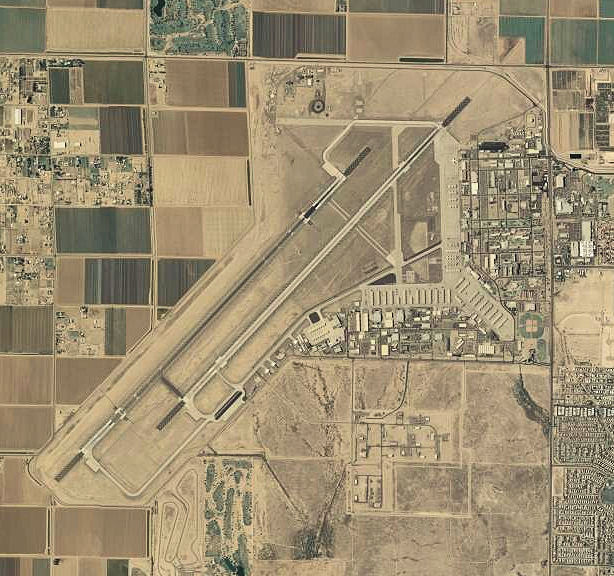

Here's a lovely overhead view.  The rectangular patches around to the north and west are farms, the green patchy area to the south is a golf course, and the dense-packed area to the southeast is regular old housing.  There is no wall, only a couple of chain link fences, a draining ditch, and a clear line of sight to the flight-line in most areas.

While unaccompanied airmen often live on post, families live off-post in privatized housing or anywhere else they want in the community.  They and their families attend local schools, including colleges.  They shop in the same stores.  I live half a dozen or more miles away and I've seen at least 4-5 airmen from Luke AFB who live in my apartment complex, probably with their wives/husbands or families.

Yes, that's right.  The same pilots that will be flying those F35's to come bomb your neighbors into submission live in those same neighborhoods.  The people they will have to kill will be their neighbors and odds are, they're going to not make many friends when they do it.

Even funnier, across the valley in Mesa, is the primary manufacturing plant for Apache helicopters.

Again, an airfield surrounded by a chain link fence with the people who work there often veterans themselves and living in the same community.  Those attack helicopters require spare parts and, yes, the Army have quite a lot on hand.  However, the would likely be the only parts they would get until it was all over and there's a good chance the people they would end up having to fight include some or all of the people making the helicopters.

See, what most people don't understand is--when the US military fights abroad and we support them--there is no need to isolate them here at home.  There's never been a need to do more than a general security effort at keeping thieves from pilfering military supplies.   They literally travel over the same roads and rails that all of our other supplies do.  There is little or no risk to having easy access to the military's bases, the manufacturers of military gear, the recruiting centers and training posts soldiers, sailors, marines, and airmen pass through on their way to a more permanent posting, often back in the same sort of neighborhoods they grew up in.  

If the US military ever finds itself fighting the US people, it's going to be point blank and personal on the same streets everyone lives on and everyone's home and family will be at risk.  If the military is smart, it will either find a way to sit out the war or it will immediately side with the people.  

If it isn't smart, it will rapidly find it's posts and armories threatened and a source of heavy weapons for the people at large. 

So, every time I see memes like those up top there, it makes me wonder just how little the people making them understand the life of their neighbors and what risk that lack of understanding puts the rest of the country in every time they politically bet on it.

Monday, December 1, 2014

Don't Tread on Me in the modern era: Logistics, Economics, and armed insurrection.

When reading Raza Habib Raja's recent article in The Huffington Post, I was struck by the number of comments claiming that guns were needed "to keep a tyrannical government in check" and that guns were a "means to overthrow an unjust/tyrannical government." What Gun Advocates Should Remember: You'll Never Overthrow The Government and It Isn't Scared of You
Two things wrong with the author’s assessment:

  1. The US national debt.
  2. Logistics.

Let’s look at the second one first.

Logistics is the military and civilian science and related techniques of providing supplies and resources to an organization and its components.  Unlike military units from the origin of the nation to the US Civil War which could often procure most of its needed supplies locally during campaigns, the modern US military lacks that capability.  The complexity of the gear and the sheer amount of fuel, ammunition, and other supplies used during an operation prevents it.  Even units utilizing wheeled vehicles in lieu of tracked vehicles and aircraft require quantities of fuel, food, batteries, and other supplies as to be disruptive to local supplies, even if they aren't requiring large quantities of ammunition.

This is usually supplied by the military’s own supply service which is—often—some combination of military personnel and civilian contractors, even in combat zones like Iraq.  While military personnel often can provide some level of self-protection, they (and civilian contractors) often require combat arms or military police personnel and vehicles to supplement their own basic small arms and automatic weapons.

In a combat zone overseas, these supplies move from secured bases where cargo arrives via military or civilian contract aircraft, trains, or shipping then overland in protected convoys or through the air using helicopters or regional/tactical cargo aircraft to the end user.   These convoy routes would typically be secured and transit times varied to try and deny the enemy the opportunity to execute ambushes on these comparatively “squishy” targets.

Within the US, these resources are semi-centralized at various arsenals and military posts spread across the country.  Currently—in a “peacetime” environment—these supplies—short of actual, complete weapons systems and ammunition—travel the roads, rails, and airways with little fanfare and almost no added security except the occasional (civilian contract) armed guard.

(This is—of course—ignoring both the possibility of extended operations requiring more than basic, on-hand replacement parts and vehicles/aircraft and the possibility current armed forces members might align with “rebels” rather than the government.)

Why is this relevant to an armed insurrection?

Simple, any time a large military force would be deployed, it would have to do three things:  guard itself, guard its supply routes, and guard its own and local bases.  To do so in a modern environment with real time communications, almost free access to the same routes military convoys would need to cover, and the sort of rules of engagement the US government would have to enact to reduce both the risk of military members not complying with orders to attack civilians and reduce damage to current infrastructure would likely hogtie a very large chunk of any military force.  Add to this the fact we have a (proportionally) small quantity of military units and personnel and the personnel needed to simply secure the supply lines and bases (and direct sources of supplies, like refineries) would probably dig into civilian law enforcement resources (assuming, again, that the civilian law enforcement personnel choose to align with the Federal government) as well.

Alternatively (or additionally), security could be increased by simply restricting civilian traffic and access to military bases, supply routes, and the like.

Which brings us back to the first error…

The national debt.

Unlike the start of the Civil War and/or the period surrounding the Shay Rebellion, we have a national debt several orders of magnitude higher and highly dependent on both the day-to-day economy of the US simply to stay solvent and one that’s very susceptible to disruptions.  Where the government of Washington or of Lincoln could write IOU’s to creditors and have them—at least for a short period—be willing to take such bills on faith, trying to do the same today with the Federal government essentially financing its debt with debt already is a lot less likely to be acceptable.

Even at the high water mark of debt post-Revolutionary War, national debt was 35% of gross domestic product and the high water mark of the Civil War was lower at 33%.  Today, we're above the 100% mark.  An armed insurrection willing to risk the stability of the Federal government and/or intent on divorcing themselves from the current system need only challenge the economic system by threatening to (or actually) reducing the US GDP.

Or, in other words, all an armed insurrection need do to cause the Federal government enough pain to risk its survival in modern times is to stop working and present enough of a threat to make the US military shut down enough freeways, railways, and airports to be disruptive.

For its own protection, of course.

So, in the words of Dr. Henry Kissinger:
The conventional army loses if it does not win. The guerrilla wins if he does not lose.  –Henry A. Kissinger

In this case, the US Federal government is in dire straights--even if the people it hopes stay on its side, stays on its side--simply because of how dependent it is on relatively smooth sailing in the economic arena.  All a modern insurrection needs to do is make enough economic hardship and watch the Federal government collapse under its own weight.

For that, a couple rolls of quarters in a sock and some purloined military or police weapons might do.  With the ease of availability of small arms, the level of training available to and within the civilian populace, and the degree of technical knowledge within the modern US population, it would be a rough time for everyone.


Sunday, November 30, 2014

My take on black-on-black crime and Ferguson.

The "Black-on-Black crime" moniker is racist rhetoric functioning under the guise of concern for the state of Black America. People of all races -- Blacks included -- seemingly love to discuss how not killing our own and being more respectable will alleviate the effects of racism. What Does 'Black-On-Black Crime' Have to Do With Ferguson?
What does black-on-black crime have to do with Ferguson?

From an idealistic point of view, not a whole lot of anything.

From a realistic view?

Potentially fewer dead black men.

Why?

Police officers are expensive, available in finite quantities (effectively), and require a relatively long period of training and experience to do their job well.  Very few governments have the “luxury” of too many well-trained police officers.   Additionally, police agencies are in competition for well qualified officers.  Being well-trained and certified (if the state requires it) is an entry ticket into agencies that may pay more.

This means three things:
  1. Communities with lower tax bases will often have either fewer police officers than they may desire and those officers it does have will often be skewed toward less experienced officers (who are willing to work for less in exchange for training and experience).
  2. Communities with lower tax bases should have issues retaining well-trained personnel in competition with other agencies.
  3. Assignment of officers will often be less than uniform, with lower staffing in areas where need is perceived to be less.

The usual explanation for black crime is socioeconomic status (SES).  In turn, lower SES is a problem for community governments serving low SES areas.   This means the previous problems should often occur in black-majority communities.

That still doesn’t really talk about black-on-black crime.

It doesn't, however, in any area with a higher crime rate compared to others served by the same police agency, the priority will be to focus numbers of officers to those areas.  Increased numbers of officers—due to crime rates in lower SES areas where many blacks live—increases the number of potential police-civilian interactions.  Additionally, it likely increases the potential that the police officers involved in these interactions are less experienced or those who aren't qualified in some manner to be offered a higher paying position elsewhere.

Reducing black-on-black crime in majority black communities reduces some of crime’s effects on SES (and increases the likelihood police will be better trained and paid) while decreasing the pressure for police agencies to staff as many police officers in a particular area (reducing the number of police-civilian interactions).  This combination does nothing to directly address the idea of racism in the justice system as currently espoused in the media; it only serves to remove the vehicle for potentially lethal interaction between police and civilians.

And it's those interactions that seem to be what's going bad for black men with the police...


Saturday, November 29, 2014

An illustration of why the boycott may not be the best idea...

In regards to what I was saying the other day about boycotting and self-inflicted wounds.  The last line of this linked news article sort of illustrates the point:


A Walmart store near Ferguson decided to cancel Black Friday sales, and merchandise was moved to other locations in the St. Louis area, employees said. "St. Louis-area mall closes on Black Friday as Ferguson protests spread"
Or, in other words, "We're getting the money for these goods, just from other people."  All of which means--in the big picture--"We're responding to your actions by focusing on other people we can make money off of."


"Voicing your opinion is not enough," said Sergio Uzurin, a protester in front of Macy's flagship store in New York. "You have to disrupt business as usual for this to happen and that's the only thing that's ever made change. It's the real way democracies function."  "St. Louis-area mall closes on Black Friday as Ferguson protests spread"

I don't think the protesters who think like this man really understand a couple of simple business facts.  First, the incentive to sell isn't always purely based on the quantity of items sold, it's based on the marginal value.  You can make more profit by either selling more at a profit and/or losing less.  Boycotting, especially sustained boycotts, drive down the total amount of sales which should increase the cost per item to the consumer unless the stock can be stored without loss until after the boycott is over.  

By forcing sales down--if the company can't identify a way to cut losses--the company will probably try to recoup their losses and/or make profit by increasing the price asked.  On these boycotts, especially if it's along racial lines, it's may be easier to simply identify which stores are being boycotted and shift product--like Walmart did--to stores not suffering from the boycott and/or to cut overall production if particular products are more likely to sell only in the boycotted areas/stores (pre-boycott, of course).

So, essentially, by boycotting, you're kneecapping how responsive corporations are to your demand for any product that's not either universally salable or is otherwise of limited durability.

Again, a better way to have tried to handle this would have been to identify corporations and/or institutions who support your cause and publicly support them.  Provide them incentive for ongoing support by making yourselves profitable to them.

Still, just a lay-person's assessment.

EDIT:

This story: Black residents protect white-owned store in Ferguson is another form of non-boycott support, albeit at the very small scale and as a small-group rather than "racial" group level of action.  In this case, several black men took an overt, risky action to support a business that had supported them in the past.  It's almost garuanteed that future actions by this particular business will give great consideration to the interests of the local African-American interests in business decisions.

Friday, November 28, 2014

Michael Brown and the Intercultural Conflict

The more I read about Michael Brown, race-relations in America, and the perception of a “war on black people” many see based on their race, the more I simply see intercultural conflict which actually crosses just about every “racial” and “ethnic” line ever.

See, it’s actually not about race; it’s about identity and power.  When it comes to African-Americans, it’s more “black and white” simply because many African-Americans create their identity based on their skin color and—for many of them—their cultural background and norms follow from that so there’s very little difference between the lines circumscribing their “race” and their “culture”.  For the rest of us—especially “generic” whites—we don’t really do that.  Instead, our identity is often delineated by class, religion, familial origin, locality, and many other factors we use—instead of color/race—to determine who “us” is and who “them” is.

We typically only see a black/white dichotomy when a large group of non-white people essentially force it onto us or focus only on skin color.  Otherwise we may see ourselves as different from the next group of white people down the block or in the next county or under the next church/synagogue/mosque next door as we do between black people and ourselves.  Or, or me personally, some combination of being poor, blue collar, and without much in the way of credentials for most of my adult life.

That’s actually a natural tendency.

See, humans and even our closely related kin—the chimpanzees and bonobos—are very good at establishing a cohesive in-group, even if it’s with someone we don’t like.  Then—within that in-group—we usually build relationships along with a set of rules and norms that essentially gives a “discount” for living to people within our group.  That discount may be shared food, support with child-rearing, collective protection, and many other actions that require some level of sacrifice or risk on our individual parts but which usually end up being a collective good.

With such “discounts” comes the possibility of others taking advantage of us and inducing cost on our parts with no resulting benefits.  Because of this, I think, we make definitive distinctions, often to varying degrees, based on identity and how much we’ll risk on others.

When such small groups can live in (general) isolation and being isolated is risky and costly, it also serves as both motivation and means to create and enforce rules to protect the advantages. 
Our problem is one of both larger groups—where the personal relationships needed to reinforce such behavior become problematic—along with the idea and ideal of “universal group membership” where everyone can partake in such discount agreements.  Once beyond the ability for individual relationships or mutual beliefs—like religion—to compel non-opportunistic behavior, most people see others they can’t identify with as risks.  When such outsiders clearly define themselves as such or are clearly definable and define themselves as outsiders through behavior, the differences in identity can have clear-cut consequences along the lines of those distinctions.

Again, this is why you can get low-discrimination groups even with the same races, like the military, when the group is clearly identifiable, cooperative behaviors are enforced, and membership requires clearly communicated sacrifices to reinforce the collective sense of identity.  In this case, the discount comes with the sacrifice and membership and exceeds the differences in “race” or “ethnicity” in most cases.

In general though, for African-Americans, joining the culture at large often requires some level of sacrifice like joining the military.  It requires sacrificing one form of identity and membership in one group and adopting the identity cues and overt behavior of another group along with whatever sacrifices, dues, or costly buy-ins to join the group.  Additionally, it often means giving up the option of being overtly antagonistic to the “white” cultures they seek to join—which often alienates other African-American people.

What’s the benefit though?

In many cases, there’s a difference in economic outcomes and even political power between different identity groups.  Because there’s a discount involved, these groups tend to reward participation and compliance with group norms, rules, and identity.  Additionally, in economic terms, some of these discounts can directly impact the children and families of members, providing social connections that increase the opportunity for easier entry by children in terms of apprenticeships, initial job offers, and other sorts of advantages tied to preferences.

For an individual person making such a decision, there may be only a few opportunities to do so and they have to make a decision based on how much leaving one group and joining another may cost.  For African-Americans living in a primarily African-American neighborhood, “acting white” may have real costs in terms of things like dating or marriage partners, security or hostility of neighbors, and simply accessing the cultural discount based on race.

Why?

Because the outward behavioral and other cues are sending as much a signal to other African-Americans as it is towards the group the person desires membership in.  Additionally, when groups see numbers of members and associated qualities like “buying power”, “poll numbers”, and others as critical sources of power and influence based on racial/ethnic/religious group identity, aspiring to join other groups may be seen as a direct threat.

We also see a hint of this in the protests surrounding Michael Brown and Trayvon Martin where the behavior of these individuals was intentionally ignored, rationalized, or considered in different manners to focus—instead—on their simple, race-based identities.  Protecting the power of their stories based solely on identity and their semi-legal status as “children” at the expense of their agency as human beings and responsibility for their own actions as the same makes for a better chance of using identity-based influence on people who share those identities.

How does the action of the police tie into this?

Police are one of those groups whose membership is tied to overt sacrifice and behavioral restrictions and then accorded additional responsibilities and privileges based on that identity.  This sets them apart as an identity group as well as creates an almost artificial set of behavioral norms.  Add into the mixture the fact the behaviors prescribed and proscribed by the law—in general—are more representative of the culture at large or the average of the cultures/subcultures wielding the greatest collective, political power over time than any particular culture/subculture, and you have a recipe for varying degrees of conflict with cultures/subcultures whose own rules and norms are at odds with that which established the law. 

In turn, it’s almost a guarantee for ongoing conflict between any subculture resistant to adopting the norms and overt signs of the culture/subculture establishing the laws and promoting enforcement.  When some of the conflict comes down around criminal behavior and/or violent behavior, risks increase someone’s going to get killed in the process of law enforcement.

That’s what we see.

Black crime is sky-high.  The norms expected in black communities differ from the law, are at odds with the enforcers, and enforcers are very unlikely to extend an in-group “discount” to someone from a distinct other culture.  Part of the problem—and why other “obvious” culture/racial/ethnic groups don’t share the same level of crime rates—is likely a greater tolerance and acceptance in violent and/or related behaviors in African-American culture. 

Two obvious solutions present themselves in this case.  The first is alteration of identity and/or culture to match that being enforced.  In some areas, for some groups, this has worked.  The costs—as suggested above—may be one’s racial/cultural/ethnic identity.

The second obvious solution is to alter the laws or enforcement to match the local culture.  To do so is essentially to install self-policing within a population and to overcome differences and resistance from other local subcultures as well as tolerate whatever the effects of the changes are.  For example, the U.S.’s experiment with alcohol prohibition was something along these lines.  The consequences turned out to be a higher crime rate and some groups being rewarded economically from the ensuing inter-cultural conflict. 

Likewise, the ongoing experiment with (de-)prohibition of marijuana will be interesting to watch for what the effects of change will be, especially the consequences and how state and local government resolves conflict with the Federal level.

Either way, when it comes to the conflict between African-Americans—as a self-identified subculture/culture—and the law enforcement institutions at large, in addition to culture-specific behavioral issues, a key issue is seeing the issue in black/white lines instead of intercultural conflict.  By tying the issue into the concept of historical racism, it’s almost guaranteed to be unwinnable because there is no middle ground.  By making it costly—in social terms—for African-Americans to join the “white” culture at large, both of the obvious solutions are ruled out unless African-Americans are allowed to redefine the culture at large to match their own. 

To do so, they must contend with both an economic system tied to discounts based on “white” culture and intercultural conflict with other subcultures.  Success—in this circumstance—would generally require the adoption of “white” economic culture or the risk of breaking the economic system and being forced to rebuild it while having to deal with the resulting breakdowns of many economic and governmental institutions and resistance from other groups invested in them.


Still, the history of slavery in the U.S. is something heavy in the minds of many African-Americans and something not easy to ask many of them to give up, even if the consequences might improve their lot in American life and everyone else’s to boot.

Boycotting and Economic Relationships as Protest

Los Angeles (AFP) - US celebrities called for a boycott to take place Friday — one of the busiest US shopping days — to protest a grand jury's decision not to prosecute a police officer who fatally shot a black teen. (Agence France-Presse (AFP), 2014)
The concept sounds like a good method—if you can get enough support—of sending a message to the corporate side of society.  The only problem is that the message received—if it's received—is likely to be more marginalization of any identifiable groups through a reduction in stores and staff in areas that "underperform" on economic measures, like sales…

…which is counterproductive in many ways.

In terms of economic power, job opportunities, and building relationships with particular companies, it may be creating a challenge just like relationships with the businesses burned in the riots.

Though not on the same scale, the economic effects of the Los Angeles Riots of 1992 were long-term and are still being felt (McDonald, 2012), most starkly by reluctance of outside businesses to return or enter the area.  Additionally, competitive markets and other populations of people benefited through race-specific gentrification (Bates, 2012).  

Specifically, in Los Angeles, South (Central) Los Angeles lost a good number of African-Americans who were replaced by a much larger number of Hispanics causing a change in economics and consumer interests.  From the position of the remaining African-Americans, this loss of cultural and “racial” homogeneity twenty years later may offset any benefit of any economic recovery at that point.

So, the initial response for businesses and other economic partner is to pull back from both the area and identifiable populations who support such a riot—evidence of a broken economic relationship—because of high or the perception of high economic risk.  Then, to only reestablish economic connection once the perception the area or population has changed and is safe once again, often when the local culture has changed, often, because the local people have changed.  Alternatively, subpopulations sharing a common cultural and/or ethnic background and the resources to do so may create local economic recovery based on serving primarily their own cultural/ethnic peers (Bates, 2012; Sides, 2012).

Another effect—from the governmental side—is they have an opportunity to alter the business composition in an area (Sides, 2012).  Building permits and zoning are a governmental function.  Who may build and what may be built are often more in government hands than in the local hands.  This means the government can support or hinder different types of business from operating in an area to a greater degree than an existing situation where plankholders hold an advantage and an established clientele to support them.  Given the fact small business are probably more susceptible to not rebuilding, you're probably shifting even more power to big business who has the lawyers and money to challenge a local government’s zoning rulings.

Overall, if the requirement is to get noticed and to register the willingness for a large, identifiable subpopulation to make economic decisions by racial/ethnic category, a boycott may work.  If the end-state goal is to protect or improve economic stability for that racial/ethnic population, I’m not sure the consequences are worth it.  A better strategy may be to form stronger economic relationships with businesses that support the racial/ethnic ideology being expressed and reward them with increased economic support as leverage to encourage other businesses to follow suit.  While not in accord with the sense of rage currently being expressed by many African-Americans, playing the relationship-leverage card may ultimately be more successful than trying to create risk-aversive behaviors in businesses.

Works Cited

Agence France-Presse (AFP). (2014, November 27). Celebrities call for 'Black Friday' boycott. Retrieved November 28, 2014, from Yahoo! News: http://news.yahoo.com/celebrities-call-black-friday-boycott-050726527.html

Bates, K. G. (2012, April 27). How Koreatown Rose From The Ashes Of L.A. Riots. Retrieved November 28, 2014, from National Public Radio: http://www.npr.org/2012/04/27/151524921/how-koreatown-rose-from-the-ashes-of-l-a-riots

McDonald, P. R. (2012, April 25). Then & Now: Images from the Same Spot as the L.A. Riots, 20 Years Later. Retrieved November 28, 2014, from L.A. Weekly: http://www.laweekly.com/microsites/la-riots/

Sides, J. (2012, April 19). 20 Years Later: Legacies of the Los Angeles Riots. Retrieved November 28, 2014, from Places Journal: https://placesjournal.org/article/20-years-later-legacies-of-the-los-angeles-riots/


Friday, May 23, 2014

On becoming homeless...

Not homeless yet, but will be in a very few days unless one of the many job applications I've sent out materializes as a job offer and paycheck in record time.

Still, close enough to contemplate how I got here.

First, I haven't had paid employment for almost 6 years now.  One key factor for this was concentration on school.  

I started college late--at age 31--and for the first few years of college, the GI Bill offset most of my living requirements as well as a relationship that turned sour, then vicious.  Once the GI Bill was mostly gone--paying more lifestyle support than education for my partner--I worked part time but once the relationship turned vicious my grades dropped precipitously and I had to stop working to concentrate on classes and drag my GPA back above 3.0.

The second key factor for this long gap was when my stepfather suffered a pathological (caused by disease) spinal fracture very shortly after I graduated.  

My mother has a hard time doing many daily living tasks and my stepfather--in addition to working--took care of most of those until his back gave out at work one day.  After several weeks of trying to avoid seeing a doctor for it, he finally went in and was diagnosed with a fractured vertebra and lung cancer.  So my job became physically moving and supporting him, helping with his medication until the combination of pain and pain killers decreased enough to let him manage his own medications, and generally being the strong-back and minder for him throughout his recovery and then starting chemotherapy.

Which doesn't exactly leave much time to accept a job when you're expected to be awake and available whenever my mother wasn't which was all day, almost every weekday.

So, I didn't look for work that strongly to avoid creating a conflict with that responsibility.

Even when I did--after he began to recover enough--we went from "You must be out by X date." to the same requirement a few months later over and over prompting me to only look for full time work.

Except I 1) lacked any money at all, 2) live in a primarily industrial zone, and 3) live at the tail end of a public transportation line--all of which don't make it particularly easy to find work especially in light of another factor...

...my work history.

Not only is there a huge gap in my work history, but I also have zero experience doing food service work, sales--especially retail and call center work--and no explicit management experience.  Combined with my profound lack of "purple squirrel" skills like 3-5 years experience on computer operated lathes, 3-5 years experience doing IT support on networked Windows-based networks, a master's degree in academic counseling, a CDL with certification for school buses, etc., etc,. etc, and a recession, it's more than a little hard to jump into the job market with a full time job.

Oh, and I'm not bilingual.

But, that's not my only mistake.

See, for the last 4 years I've had only about $100 cash move through my hands.  That's total for all 4 years.  

Which really doesn't do much for socializing or maintaining social networks or connections.  

I mean, I've had internet access for most of the time and a cell phone, but when social connections are usually maintained by shared interests and activities, never being able to go participate puts social investment from others pretty low on their list and I can understand that.  

I've had friends drift into "acquaintanceship", and acquaintances drift off period, and there's very few people who I would feel okay even asking for a favor at this point, let alone something important like a place to stay or other help.

Honestly, how can I ask someone to commit to helping me out like that when I haven't gotten past an occasional initial interview in years?

I know part of the reason is the recession and location, but I feel almost like I'm not bringing anything to the table anymore.

Won't give up though.

Still hoping and trying.

Even though I'm--literally--looking for places I can hide a tent, try to get water, avoid police interaction, and figuring out how to panhandle even while I help my mother and step-father move into their new place in a retirement community.  

I've got someplace to stash most of my stuff so--hopefully, eventually, when I get an income--I can start over with at least something.  I'm looking for someplace to stash a bag with work clothes, interview clothes, a set of hair clippers, and some hygiene items so--if anyone did call and offer a job--I'd at least be able to meet them in a presentable manner.  

I've got some survival gear.  A pack, some canteens, a tent, a sleeping bag, a knife or two.  Don't know where I'd go initially.

I've applied for food stamps and other stuff, but will wait until Monday for the interview (or Tuesday, if it's a holiday). So, maybe, at least, I'll have access to food and clean water.

Still...

I still need to check and see if anyone will let me haunt their yard with a tent.  I still need to complete stashing my stuff and splitting out what I am going to take with me and what I'm going to try to get people to hold onto for me.

Maybe I'll take a notebook or two and spend some time doing some participant observation of homeless people?  Maybe, some day in the future it'll be something worthwhile.

Don't know.

Just trying to keep things together--mentally--try to throw some last "Hail Mary" attempts at avoiding homelessness out there, even while I'm full of dread.

Can't give up.  Too spiteful for that.

Thursday, March 13, 2014

Armed conflict and democracy...

Why Are So Many Conservative Politicians Brandishing Guns?

The part of this story I'l like to comment on is this:


I guess I had thought that at Appomattox Court House back in April of 1865 we'd settled the whole question of whether armed resistance could alter our democratic system. More broadly, I always believed that the beauty of democracy is that it is supposed to take violence out of the process of lawmaking. In a democracy, the vision that gets the most support wins, rather than the one with the most guns behind it.


Actually, the misadventures of the Civil War changed many things, including some which have produced our current (economic) problems as well.  The Civil War functionally led toward a decline in states' rights and the effectiveness of the 10th Amendment which carried over into the creation of the 17th Amendment and the use of the Federal level as a bully pulpit over the individual states.

Why is that non-democratic?

It's not, really, it's anti-republican and it's one reason why we have so much antipathy between so many people in so many states and the Federal level and a massive inability to control the Federal budget (and it's effects like taxes and buying off votes with benefit programs), because the Federal system was never intended to be more than a one (national defence) or two (national defence and interstate/international commerce) pony.

Unlike other systems, like the parliamentary system, there is no way--outside of the regular elections or impeachment--to rein in a Federal legislature or President who has "gone rogue" and is no longer acting in the best interests of the people.

Prior to the Civil War and the armed occupation of the South, the Federal government didn't get particularly involved in the day-to-day life of people and--if it had gone rogue--the influence of the States on the Senate would provide some level of "roadblock" for most actions.  

Additionally, most "solutions" to problems close to home--like establishing who can make decisions about what healthcare there was or who met the social requirements for being married--rested squarely on the community who would have to deal with the consequences of and had the most influence on.  It wasn't the effort to try to create a one-size fits all approach that puts most people--where there are differences in opinion--at odds with the Federal government and everyone else.

So, the armed insurrection of the Civil War didn't work and had major implications for us--including a much stronger Federal level and less power in the states--but I'm not sure the person who wrote the story completely understands the lesson.

Additionally, given the ongoing armed insurrections in Syria and other places as well as the recent and last century histories of other "insurrections/revolutions", I'm not sure that "inevitable failure" rule still applies.

Those examples and the idea the US could sustain--economically--another 4+ year military conflict within the confines of the US borders and still functionally remain a country is probably not realistic either.  Unlike the North and South, which were somewhat economically viable on their own at the start, whatever side the current Federal government would land in any future conflict, if the other side merely established a detente and a viable economy, the current Federal system would probably risk collapse from simple failure to service current debts and lack of confidence from the creditors remaining...

Oh, and the Civil War was "solved" by the side with the most guns, not necessarily the most support; democracy backed with guns.


Monday, December 9, 2013

Ran across this article today:

http://news.yahoo.com/stick-poor-congressional-strategy-080500785.html

While I'm not going to question the veracity of this author's numbers, I would like to point out a few things–as a Devil's Advocate–about some of her statements.
The idea is, if you can't pay for your home without government assistance, you don't deserve to live in one. In this spirit, budget cuts due to sequestration will take rental assistance vouchers away from 140,000 low-income families by the beginning of next year, making housing more expensive as agencies raise costs to offset the budget cuts.
This is a reference (through the in-line linked source in her article) to Housing Choice Vouchers which is undergoing sequestration cuts.  The more authoritative article the click-through story is probably talking about is here at the Center on Budget and Policy Priorities.

Basically, it's a budget reality issue.  Across the board cuts under sequestration to try and meet the budget limits are provoking agencies to try and make due with lower budgets.  One way is to reduce the number of vouchers and a second is the amount paid out per voucher.  While I'm not going to argue putting people on the street is a good thing, you do have to ask what the alternatives are and what are the likely results if no change is made.

In this case, pulling money into this program necessitates either pulling more money out of other programs (like she laments more on throughout the article) or trying to raise taxes. The irony in this second course is the people most likely to be hit by raised taxes—commercial property owners and businesses—are the same people establishing the rent amounts in the first place.  In other words, one major alternative would probably create a similar problem anyway.
If you're lucky enough to keep your home, don't expect to heat it. Sequester cuts to the Low Income Home Energy Assistance Program (LIHEAP) meant that 300,000 low-income families in 2013 were denied government support for energy costs.
The in-line link (included) links through to this article from the National Energy Assistance Directors’ Association (NEADA).  The LIHEAP is a major source of "big oil tax subsidies"  which has been a presidential and congressional target since the election of Barack Obama.  Although the story currently is driven by the effects of sequestration, the irony is this program has been in the political gun sights of many liberals for a long time and their success is also their failure in this case.

The recent reduction in Supplemental Nutrition Assistance Program (SNAP) benefits has affected more than 47 million Americans and is the largest wholesale cut in the program since Congress passed the first Food Stamps Act in 1964.
Two parts to this story.  First is the expiration of American Recovery and Reinvestment Act of 2009 (ARRA) on 1 November 2013 which was envisioned as a temporary increase during the recession.  That—by itself—is an illustration of a faulty mindset attributing temporary, exceptional measures with a status quo going forward.  The second is the basic food costs covered by SNAP are tied to agriculture subsidies—also under attack—to keep food costs low by helping to offset production and some transportation costs.  Without one (subsidies), the other costs more.

Again, a victim of potential successes.

Generally, the impression I get is one who doesn't understand the money funding these programs is somewhat finite and comes from the people of the United States (and elsewhere, in some cases) directly or indirectly.  Additionally, while it would be nice to be able to provide everything for everyone from a certain perspective, the reality is—sometimes—the best thing you can do for someone is back off and let them solve their problems themselves.

In this case, expecting the Federal government to do it for you is like betting on a racehorse to pull your kid's wagon.  The wagon might get there, but it's highly doubtful it (or your kid) will be in the condition you'd like it to be.

Friday, March 15, 2013

A War on Ergonomics and Manufacturing Standards

What amuses me about the whole Assault Weapon Ban idea is that it is simply an exercise against ergonomics and manufacturing standards.

I mean, look at it this way:

http://www.logarchism.com/wp-content/uploads/2012/12/0815d2ed-66d9-4159-8691-0c61dce8d026-new-guns-slide-1.jpg

Collapsing stock: Primary use of a collapsing stock is to adjust the length of the stock to fit a shooter better. The basic idea is to make it easier for a person using it to accurately fire and adjust to recoil without requiring a customized stock or dealing with a one-size-fits-all stock. Main people it generally helps would be women and shooters who aren't of average (male) size and build.

Folding stock: Primary use is to reduce the overall size of the weapon for storage or carry when not in use. The basic idea is simply to allow the weapon to be where the person using it is more comfortably when the weapon isn't actually being used. If anything, folding stocks increase inaccuracy in some designs and/or increase felt recoil in designs where the conventional stock it replaces contains a recoil reducing mechanism.

Pistol grip: Primary use is to change the angle of the hand to the wrist, usually to allow a more comfortable position and reduce strain on the wrist. It also tends to increase the ability to control a weapon for people--like women--who do not have a wide grip span or a high grip strength. While some people say it's to allow "spray-and-pray" hip shooting, one of the first weapons designed to allow for "hip firing" was the Browning Automatic Rifle and (early versions) used a conventional stock. Later adaptations and many of its peers used pistol grips, but were primarily intended for use from and initially were equipped with bipods as walking fire is generally less accurate than fire from a stable position farther away.

"Barrel shroud": In the "basic" form, simply a ventilated barrier between a chunk of metal that gets hot (because you have put burning gases through it) and the rest of your body/hands/etc. Sort of like the grill on a space heater to keep you from touching things that will burn you. Other "more advanced versions" may allow the attachment of things like lights (so you know what you're aiming at) and sights (so you don't hit what you aren't aiming at).

Flash suppressor: Primary use is to turn a large fireball at the muzzle (depending on the barrel length/ammunition combo) into one where you aren't trying to shoot blind after each shot. Simply, it allows a shooter to continue to identify targets/non-targets as well as not disrupt other shooters' vision. You don't typically see these on pistols because the type of powder used is usually consumed quicker reducing blast. You often don't find these on shotguns for the same reason and on long-range hunting rifles because the barrel is longer to allow greater power and accuracy.

Bayonet lug: Original use was to attach a bladed, melee weapon to your rifle in case you ran out of ammunition. Currently, most of these are more collector items than the weapons that can fit them as well as the US barrel length requirements often making bayonets no longer able to securely attach to a weapon. This currently exists--primarily--due to manufacturing standards for the various parts (front sight assembly, gas block, muzzle device, etc.). For manufacturing, the availability of standard parts shared with military models--but not parts of the fire control mechanism--often drives the presence of these.

Although not explicitly listed in most lists, the general appearance or "black rifle" look is generally based on manufacturing standards. In most cases, "assault weapons" are black due to the finishes applied and the lack of concealment of various parts by wood. Generally, this is to allow these firearms to meet requirements regarding rust-resistance, resistance to various oils or acids, as well as to decrease shine on the weapon. 

The use of wood--historically--was dropped for most military weapons because of susceptibility to humid climates, reduction of weapon weight, and simply the added cost and time to produce while being difficult to reliably meet production standards. The resulting designs--primarily of metal and plastics--also allows more modular, reliably interchanging parts between those weapons produced to the same specifications. Sort of like the parts of a modern car. 

The problem with the specifications banned is not address the lethality of the weapons or their actual use. In order to protect hunting, lethality can only indirectly be addressed through ammunition capacity because most traditional hunting rifles (and shotguns) are more powerful than most "assault weapons" because the focus for these weapons is usually on ergonomics and manufacturing standards more than lethality. Even addressing the magazine capacity--itself an ergonomic compromise between weapon weight (loaded) and how frequently magazine changes are required for the same number of rounds fired--is only applicable in theory to the first magazine fired's total capacity and should actually not matter if any time at all is required during a fight to do something like move or locate a target. 

In these cases, the ease of reloading--another ergonomic measure--reduces the limits on lethality based on magazine capacity.

Overall, however, I think the actual result of passing such a war on ergonomics and manufacturing standards without directly addressing the behavior of criminals is more likely to simply push development of decentralized manufacturing of weapons as well as "parallel" lethal technologies like pneumatic weapons to which many of these rules might not apply. Additionally, with the protection of older, more lethal weapons, the ongoing design and production of more ergonomic "chassis" to install older weapons in--like those for older M14/M1A rifles and even M1 Garands--will likely continue and exploit the lack of focus of this sort of legislation to create weapons just as lethal and nearly as ergonomic while missing the opportunity to address the criminal behavior behind these mass shootings.

It doesn't take a gun to kill a lot of people. It doesn't even take a well-designed one either.

Sunday, December 16, 2012

Gun Control: The Low-Hanging Fruit


With the recent high-profile spree killings in the news, more and more talk of gun control and another attempt to ban assault weapons is being thrown around.  The reason why it's almost useless is the fact—like people looking for a solution to this problem—guns are also the low-hanging fruit for most of these killers. 

Let's talk about killing…


Soldiers and police also deal with the possibility of having to kill as part of their profession.  However, like most people with a normal degree of empathy, they are inherently reluctant to do so.  The way they are trained to "overcome" this reluctance in the performance of duty illustrates the major difference between the spree killers and these professionals.

For soldiers, life as a soldier starts early through the creation of the idea of a shared cultural or social identity.  This lays the basis—psychologically—for the motivations to volunteer (in non-conscripts) and cooperation with conscription in other cultures.  During training, soldiers are typically exposed to a high degree of forced cooperation with other soldiers which usually results in a high degree of emotional bonding between both the soldier and other soldiers and the soldier and their organization.  This is long before any exposure to actual combat in most military institutions.

When faced by combat, most soldiers are then presented with an emotionally relevant situation where they can choose not to kill an enemy but the risk of not killing them is in terms of the lives and well-being of the soldiers around them.  In these situations, the enemy is often from a distinct "other" group and/or is presented as such by military and usually civilian authorities as well as—often—the enemy themselves.  This means the decision to kill is one of empathy for a stranger versus empathy for your comrades and—depending on the country—your people, country, etc.

This dilemma—although enabling most soldiers to kill—is also a likely root cause for some post traumatic stress disorders.

Police—while using similar methods of group-creation training initially—are presented with a different problem because the social group they are nominally protecting ("the Public") is also from where the potential "target" they may have to kill comes from.  In some cases, they will use the same sort of psychological distancing as soldiers when the enemy presents itself as a distinct social entity like a gang, but the primary decision maker for police use of lethal force is the concept of immediate threat.

For police, the dilemma they have to resolve is one of immediate threat to themselves and to bystanders from a particular person in a particular situation.  The "releaser" for the ability to kill is their emotional attachment to themselves and others in the somewhat nebulous concept of "the Public" and their natural reluctance to kill other people.  This dilemma may also result in post traumatic stress disorder when the officer is unsure of his or her actual assessment of the threat presented or has an unwillingness to accept it after the fact.

In both of these paradigms, the only legitimate targets for lethal force are directly or indirectly threats toward someone who they also have an emotional attachment to.  This is one reason why the crimes of spree killers seem so outrageous and horrible to us. 

Let me explain…


The commonality between all of the recent—and not so recent—spree killers is not necessarily the use of guns, it's the history of untreated or undertreated mental illness combined with an average or above average degree of intelligence and enough planning and preparation to make for a large body count.

The body counts in these incidents are because these men have by design selected target locations and times to maximize the number of non-threatening targets given the weapons they had at their disposal at the time.  All of these crimes had some degree of pre-planning involved.  In some cases—like the Aurora shooter and the shooter in Norway—there were months of preparation and the creation of complex plans.  All of these crimes had locations selected that took into account the availability of defensive measures for their victims. 

Again, for the Aurora and Norway killers, the secondary explosive devices made were intended to distract local law enforcement.  For the Columbine event, the explosive devices were intended to create a distraction and probably allow a greater concentration of targets for the shooters, but this didn't materialize.  The Virginia Tech shooter did not use explosive devices; however, he did prepare and bring chains and locks to manipulate his targets response by restricting their ability to escape.

In these cases, the spree killers show a high degree of analytical problem solving and understanding of both their victims' and law enforcements' responses.  This also reveals that these men intentionally selected targets for their inability to defend themselves and probably used laws regarding firearm restrictions to their advantage.

None of which is why I think gun control is a waste of time to stop these sorts of killers.

Why is gun control probably a waste of time against these killers?


Gun control is a waste of time against these killers because they are not stupid and are usually very aware of these restrictions.  The selection of firearms—even in the cases where bombs were also used—is more likely a compromise between ease of use and the degree of personal involvement in the actual killing.  Similar spree killings in places like Japan and China have so far relied on melee weapons including kitchen knives and cleavers with similar targets—school children—possibly as a response to increased difficulty acquiring guns. 

For the Norway killings, the killer maneuvered through the firearm laws of several European countries in order to acquire the weapons and explosives he used.  The Aurora shooter—likewise—maneuvered through the legal requirements of several jurisdictions to assemble his "arsenal" and explosive materials.  Others simply didn't have to go as far.

For the Sandy Hook shooter, he used weapons available at home and Columbine shooters used a combination of available weapons and weapons purchased for them by another person.  In all of these instances, cars or vans were also used to transport weapons to their targets of choice as well both in vehicles provided to them or acquired by other means.

While restricting access to firearms might on the surface seem to be a means to reduce the number of casualties, my issue is with the possibility it might work.  For all of the shooters mentioned so far, the firearms used appear to be the weapon with the lowest opportunity cost to use but with the highest degree of personal involvement in the actual killing.  Assuming we could somehow get an effective weapons ban—for these type of killers—you're simply increasing the opportunity cost for one type of tool.

This doesn't stop this sort of non-empathetic, intentioned killer.  It merely makes them find another tool for their tool box.  If—like in the Chinese and Japanese school massacres—it forces them into a less lethal but more personal weapon like a knife or cleaver, it might reduce the number of families dealing with dead children.  If—like in the Aurora , Norway, and Columbine incidents—explosive devices are already on the menu, it might simply make the killers forego the killing of many people one-at-a-time and go for a larger, single or multiple killing with more casualties.

My point is these men (and all have been men so far) have yet to allow a law to stop them from killing.  The only thing that appears to change is the amount of planning time and the higher number of casualties.  The focus on trying to "limit" the number of dead by banning weapons when you have already seen multiple killers using a potentially more lethal set of weapons is ludicrous and is a recipe toward creating even larger number of casualties as these men adapt to using different weapons to kill with.

The solution—the only solution, in my opinion—is to focus on making these situations result in only one—the perpetrator—or ideally zero casualties. 

"He was a quiet boy…"


Almost all of these spree killers operate in a social vacuum.  While they have acquaintances, most of them lack close, emotional attachments.  This may be both a symptom and a cause of this violence.  This is a symptom because it enables the degree of planning involved with a lack of outside interference.  For many of these killers, the first kill is usually their parents, whom they live with.  Outside of their family—and with their family out of the picture—most of the restrictions on these men's behavior vanish and it enables them to go out and kill.

The first step to preventing these killings is simply social involvement and mutual investment with the people around you.  If someone can't or won't emotionally engage, those people need to be identified and professionally assessed.  

If they lack the ability to demonstrate empathy toward other human beings, they need to be positively controlled, monitored, and kept out of situations where that lack of empathy can present itself in a violent manner.  This may mean medication, secure facilities, or something similar to prevent them access to the means of doing harm to others.  That's knives, guns, cars, bombs, information, etc..

If they have a history of violence as well, there should be an obligation to restrict them from interaction with the rest of society.  These are demonstrations—for those who look—of the lack of empathy that restrains everyone else in society from doing overt harm outside of extreme circumstances.  These actions should be documented and remain searchable in order to prevent access to locations, situations, and the means to allow large scale killing.

Most mentally ill people aren't this way, but most of the spree killers are mentally ill—in other words, someone noticed there was something wrong—and no one took definitive action to stop them.

Why?


Because it's not comfortable to make decisions about someone else when you're worried about people making decisions for you.  The problem is, until we are willing and able to, the killings will go on and—as the low-hanging fruit is disposed of—probably get worse as they adapt to the rules we set for ourselves.